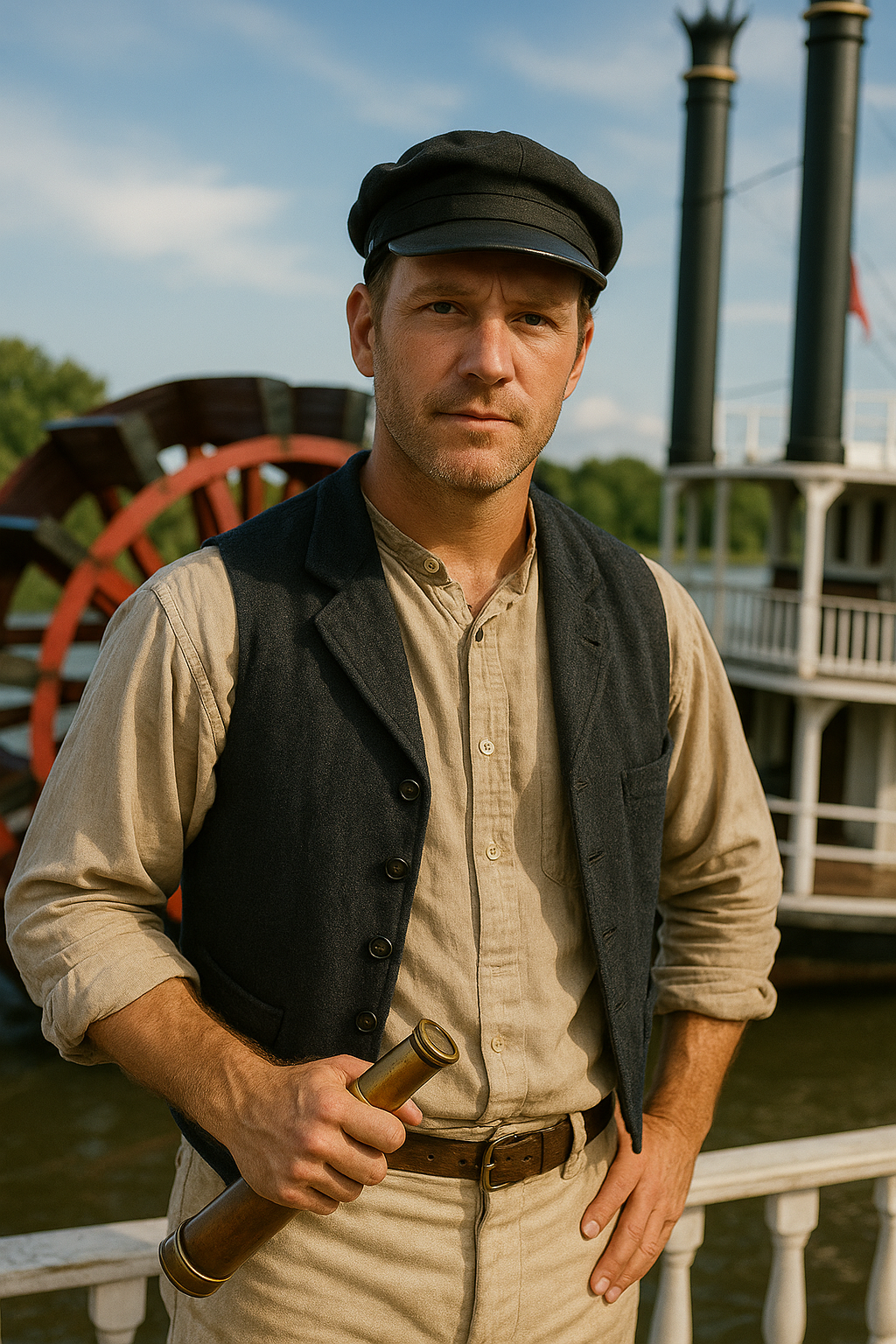
Name’s Tink. Deck’s my stage and the river’s my teacher. If you hear the whistle at dawn, that’s me turning a sleepy crew into a working one.
The Far West rides light and fast, but the Big Muddy is never the same twice. Sandbars shift, snags move, and one bad call can cost a hull. So we drill, we watch, and we work like a clock.
Work & Mission
- Guard the Far West against snags & bars
- Oversee freight handling & security
- Monitor fuel, cordage, and boiler wood
- Maintain strict deck discipline & safety
- Keep passengers calm & schedule reliable
- Ensure the happiest, steadiest boat on the river
Responsibilities
- Lead deck crew: mooring, lines, & landings
- Run daily safety drills; watch rotations
- Assist captain with navigation & hazards
- Coordinate wood-yard stops & fuel counts
- Inspect spars, blocks, & cables for wear
- Manage the manifest: cargo, freight, & people
River Knowledge
- Reading channels, cuts, & backwater eddies
- Spotting deadheads by ripple & swirl
- Whistle codes for bends, fog, & danger
- Double-watches during spring rise
- Precision “grasshopper” maneuvers
- Judging safe anchorage in storms
Connections
- Freight lines serving merchants & posts
- Soldiers, settlers, survey crews, & scouts
- Respect with Captain Grant Marsh
- Contacts at Bismarck, Pierre, & Benton
- Ties with quartermasters & wood-yard owners
- Indian agency agents & trading houses
Gear
- Spyglass for scanning banks
- Heaving line & sounding pole
- Oilskin coat, river cap, oiled boots
- Cargo manifest & tally sheets
- Carpenter’s kit for repairs
- Spare cordage for emergencies
Background
- Born in Gettysburg, PA (1844)
- U.S. Army veteran (20 years, First Sergeant)
- Married to Vivian; home in Sioux City
- Disciplined demeanor; calm under pressure
- Quick with tools & plans
- Expert on Missouri River moods
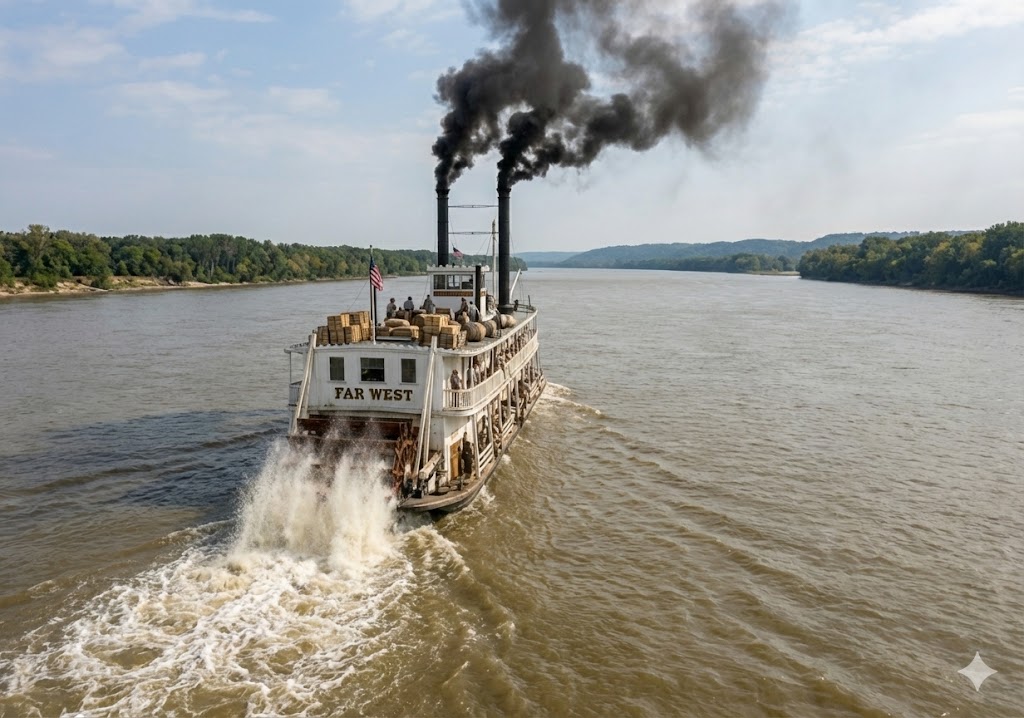
Steamboat Far West
. . . . . . . .
Light, fast, and built for the Upper Missouri
She’s called the Far West, and I’ll tell you straight—there isn’t a better shallow-draft sternwheeler working the Upper Missouri or the Yellowstone. Built light, built smart. She rides high and quick, slips right over sandbars that’d leave heavier boats stuck and swearing. When the river gives us room, though, she’ll haul more freight than folks expect just by looking at her lines.
Most days we’re moving everything the frontier can’t live without—supplies, trade goods, and settlers. Upriver runs mean hard pushing, boilers working, crew sweating. Downbound? That’s when she flies, sternwheel churning and the banks flying past.
The Upper Missouri
“On the Far West, the Missouri is our lifeline” — but she’s never the same twice.” This river isn’t a stream. She can run narrow with a deep, fast channel one minute, then spread herself wide—more than a mile across—the next. Alive, beautiful, dangerous, and always changing. You don’t travel her careless. You listen to her!
And through all of it, there’s one thing we’re always hunting: the channel. That’s our lifeline. The thread of deep, moving water that’ll float the Far West. The pilot has to read the river like a living thing—watch the set of the current, the color of the water, the way it slides and bends. You never expect the channel to be where it was yesterday. Sometimes it turns quick, and you have to answer just as fast, which isn’t easy with a boat our size.
The Upper Missouri River is our highway, and it is a beautiful voyage and a dangerous one if you are not careful. The river is always changing. The water in the River is so powerful it sometimes is hard to believe. You can see it boil, churn, swirl and shoot up in the air. I’ve seen it suck under a 40 foot cottonwood tree with ease and not give it back. It cuts away banks, 4 and 5 feet at a time, dropping a forest of cottonwood trees into the river.
“But that’s only one face the Missouri River wears.”
Then there is the other side of the river. The days when she turns gentle. Peaceful enough to fool you. Water slapping soft against the hull, a cool breeze coming off her surface, the steady motion underfoot. That’s the part of her that got hold of me. I don’t reckon there’s another place in the world where you’ll see what the Missouri shows you if you give her time.
Flocks of ducks and geese so thick they darken the sky—thousands of them lifting at once. Paddlefish rolling on the surface, fifteen feet long, ancient as the river herself. Deer, elk, antelope standing along the banks, watching us pass like we’re the strange ones. And the hunters too—big wolves moving quiet, coyotes clever as sin, foxes working the edges for their daily meal.
Out here, the Missouri doesn’t forgive guessing. But if you learn her ways—if you respect her—she’ll carry you farther than any road ever could.